Inside the local Commander.
Speech recognition, constrained decoding, deterministic tools, and spoken feedback—inside the browser.
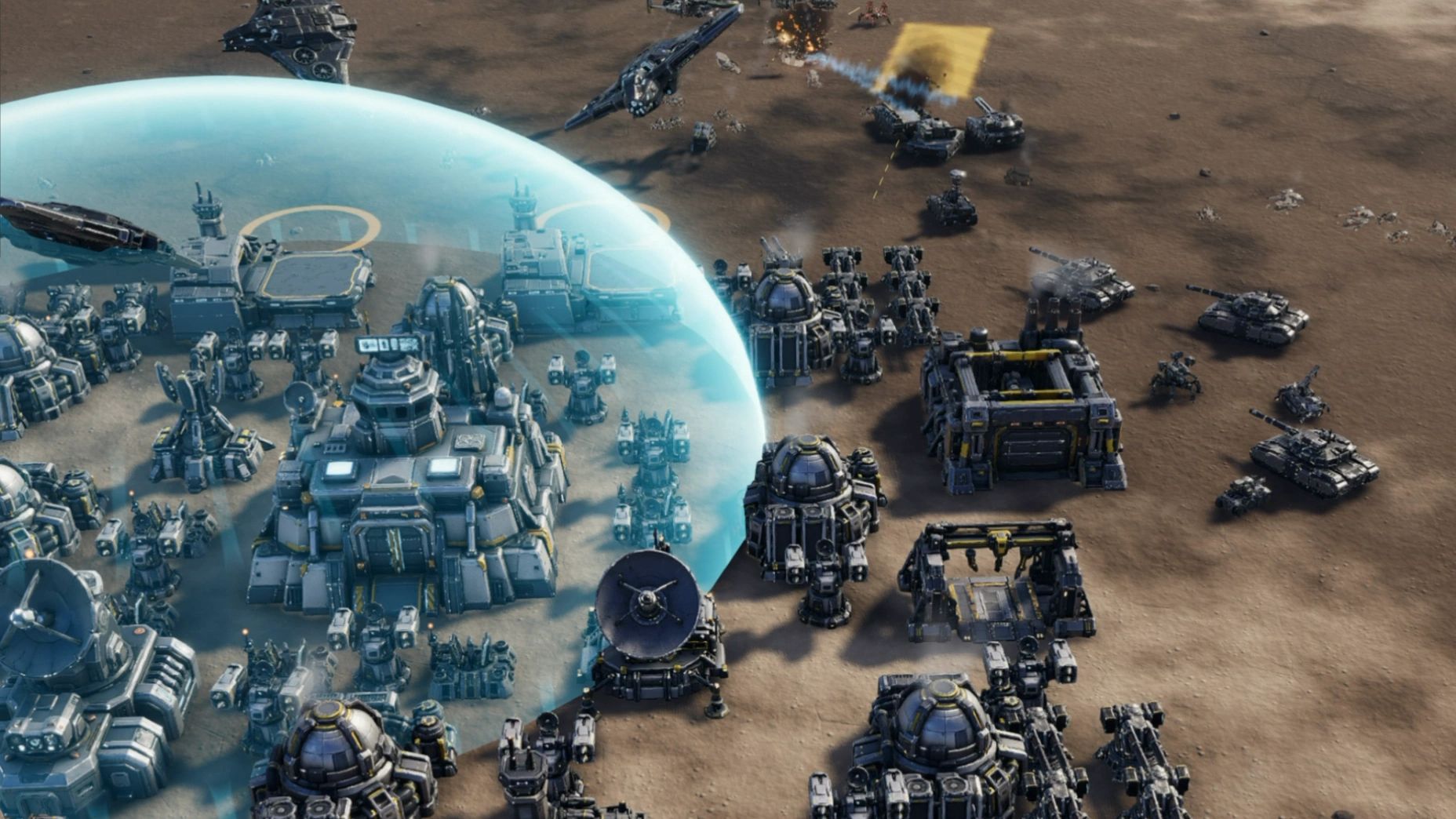
Start with the moment, not the model
A strategy game asks you to manage several kinds of attention at once: the base, the front line, the next wave, and the controls between them. The Commander began with a practical question: could an order become action without pulling your attention away from the battlefield?
Early versions used a cloud conversation service. That established the interaction, but it also connected a core game feature to a remote service and a recurring inference cost. In October, the default architecture moved onto the player’s own device.
Three models. One narrow responsibility.
Moonshine recognizes speech. A fine-tuned LFM2.5-350M model translates intent into a compact command language through wllama. Kokoro supplies spoken feedback. The game’s own tools validate and execute the result.
The command model does not need to reproduce the entire simulation inside its weights. The game already knows where units are, what resources exist, which buildings need power, and which orders are legal. A smaller model can do useful work when it speaks a precise language to a system that owns the facts.
Understanding is not permission
An analysis request must not become a construction order. A recommendation must not spend materials. A contextual follow-up must not revive an unrelated instruction from earlier in the conversation. These are product requirements, not optional refinements.
The architecture separates interpretation, policy, planning, and execution. Read-only questions remain read-only. Proposed actions can be previewed. Delegated behavior stays within its authority and budget. Direct player control retains priority.
Local has real tradeoffs
The documented model set is approximately 505 MB. Downloading, caching, initializing, and sharing device resources with a 3D game all matter. A capable browser is a delivery platform, not a guarantee that every phone or laptop will perform equally well.
Once the required assets are loaded, the local path does not call a model-serving API for each order. That removes a recurring inference charge; it does not remove hosting, bandwidth, support, or hardware constraints. Microphone use remains optional.
Measure the boundary
The October engineering record reports 160 of 160 held-out text cases handled correctly and 98.8% speech-to-command accuracy under its specified noisy test conditions. It also records 0.36–0.60-second decision latency on the tested MacBook.
Those numbers describe a particular evaluation. They do not mean every sentence will be understood, every device will be fast, or every compound order will succeed. The reliable experience comes from testing the limits, making failures legible, and keeping the simulation in charge.
A bounded command protocol
The command model is a fine-tuned LFM2.5-350M exported as a Q4_K_M GGUF of approximately 229 MB. Grammar-constrained decoding produces a compact protocol instead of free-form tool instructions. Moonshine Small Streaming handles recognition; Kokoro supplies voice through the Moonshine runtime.
Training combined templated commands, teacher paraphrases, and recognizer-augmented examples. The held-out evaluation was kept separate. Small models became practical because battlefield intelligence and legal execution remained responsibilities of deterministic systems.
The source engineering record describes same-origin, content-hashed model files and browser caching. WebAssembly threading requires cross-origin isolation. Download size, cache retention, initialization, and mobile memory remain practical constraints. The current private package includes the local models and disables optional cloud paths; this website does not activate a microphone.
Based on the development retrospective through November 1, 2026. Historical test figures describe their recorded workloads; they are not new compatibility or performance guarantees. Rampart Zero remains in development.
Explore the gameThe engineering behind Rampart Zero.
From a browser prototype to a deterministic campaign, built through explicit specifications and repeated verification.
Inside the asset forge.
The production path from generated candidate to articulated, optimized, game-ready machine.
The systems of recovery.
Repair, salvage, servicing, and the deterministic autonomy that supports a player’s intent.